Enterprise Architecture Management

Effective Enterprise & IT Architectures

EAM is the navigation system for your transformation. Effective enterprise and IT architectures are the foundation of your success

Master complexity, gain agility. We design architectures that deliver measurable value, support and accelerate your business, boost your efficiency, and sustainably reduce IT costs. An effective EAM is essential for efficiently unlocking the potential of AI and transforming data silos into value-adding assets.

Benefit-driven implementation and integration within the company

Further development and implementation of the current business model through Business Capability Management, Lean Demand Management, Data & AI & Organization 4.0, and the definition of your target business vision.

Quick Start & Expansion of EAM with or without EAM Tool Evaluation and Implementation

A results-driven implementation and integration within the company, starting with Quick-Start: Mastering complexity & planning and managing digital and AI transformation.

We ensure a quick start with no unnecessary overhead but with tangible added value. Whether with or without tool support, we guide you every step of the way—from the initial assessment to full integration into your organization.

Quick-Start EAM – Get up and running quickly at a fixed price

The focus areas are determined on an individual basis according to specific requirements

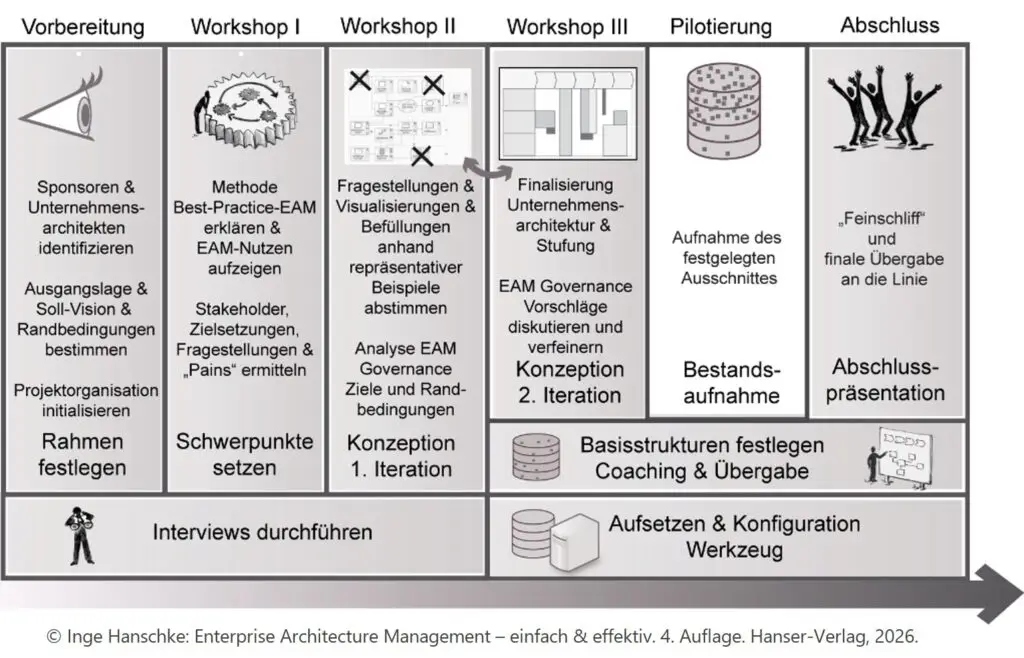
A systematic and comprehensive high-level design of your enterprise architecture management in two half-day workshops, resulting in the following:

The EAM high-level concept sets out the key parameters for the EAM rollout and its subsequent phased implementation:

  • Preliminary assessment of the current situation
  • Constraints and EAM Maturity Level
  • Relevant stakeholders (and stakeholder groups) and their objectives
  • Relevant and prioritized objectives, questions, and EAM responses
  • Key aspects of EA governance, including roles, responsibilities, and committees, as well as integration into planning, decision-making, and implementation processes
  • Integration and tool requirements as general guidelines for tool evaluation
  • Recommendations for the next steps in a value-driven EAM implementation

Comprehensive development and design of your target vision, EAM objectives, questions & EA answers, EA structures, and EA governance, as well as planning for the next phase of implementation. If desired, this includes a streamlined EAM product evaluation.


Quickly establish a solid foundation for expansion

Business Architecture for Digitalization

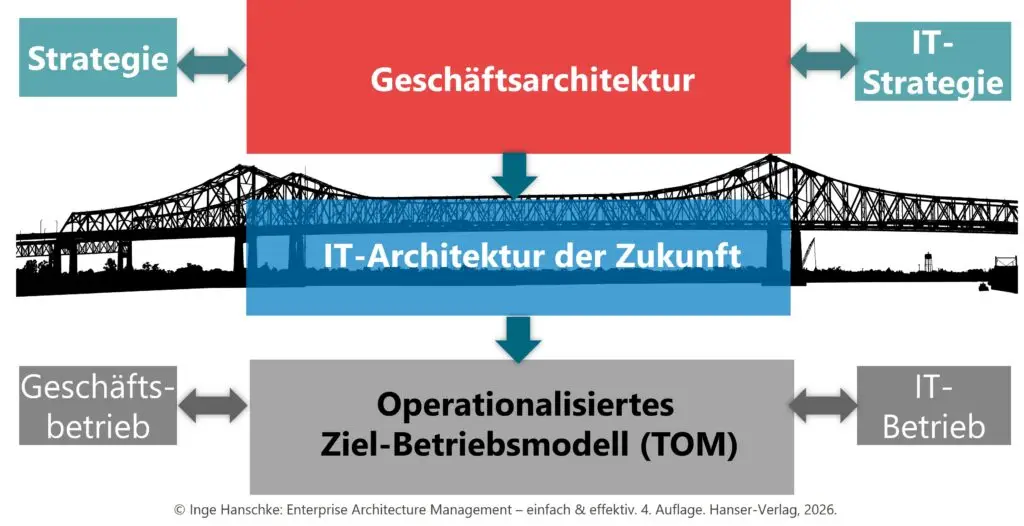
We align business strategy with IT development. We ensure that every technological investment delivers direct strategic value and secures your business model for the future. Key to this is the further development and operationalization of your current business model through Business Capability Management, Lean Demand Management, Data & AI & Organization 4.0, and the definition of your business objectives.

A business architecture visualizes the current business model, provides a framework for further business model development, and supports its implementation. Key elements include:

  • Business Capability Management
    A systematic approach to identifying the business capabilities that are currently or will be relevant to the company’s operations and to ensuring sufficient business agility.
  • Data Management
    Providing all data in appropriate quality for data-driven business models and optimal use of data, while ensuring data protection and information security
  • Business Process Management
    Identification, design, documentation, implementation, control, and optimization of business processes to ensure efficient and effective business operations
  • Lean Portfolio and Demand Management
    Systematic management of the strategic and operational portfolios. Lean Portfolio Management focuses on the “what” and “why” at the strategic level, while Lean Demand Management addresses the management of demand flows.
  • Innovation Management
    Systematic and interdisciplinary planning, management, and monitoring of innovations including trend scouting, innovation controlling, and design thinking workshops
  • Organization 4.0
    : The Organization of the Future: Necessary Organizational Changes to Prepare for AI and Digital Transformation

Key steps:

  1. Business Drivers & Operating Environment
  2. Derivation of the business target vision (through storytelling and business capability management, among other methods)
  3. Operationalizing the technical target vision
A systematic, lean, and effective vision

Simple & effective: take the next step

Talk to us about the challenges you’re currently facing and find the right support for your project